02 03 04

Selasa, 18 Januari 2011

Pictures of the Universe


Pictures of the Universe


Spectacular NASA images of interesting scenes in the universe.

A collection of images representing some of the most impressive views in our universe. Included are the Orion Nebula, a dying star, spiral galaxy, birth of a star, the Eagle Nebula, extrasolar planet, a galaxy pair and the Cartwheel Galaxy. Many of these are false-color images, enhanced to yield an artistic view.
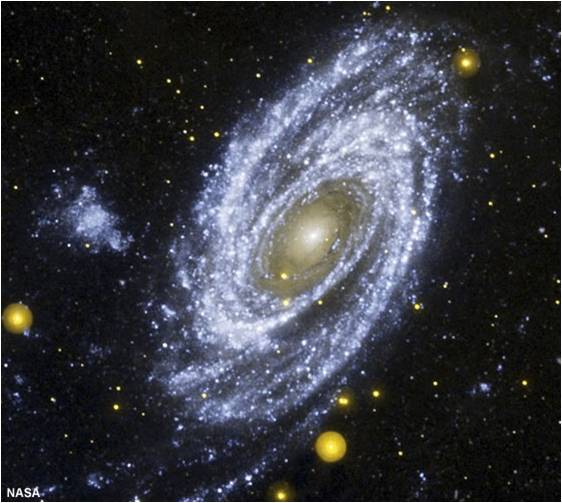

 Spiral Galaxy: The magnificent M81 spiral galaxy takes center stage in this ultraviolet image from NASA's Galaxy Evolution Explorer. Young stars appear as wisps of bluish-white swirling around a central golden glow, which comes from a group of much older stars.
The large fluffy bluish-white material to the left of M81 is a neighboring galaxy called Homberg IX. This galaxy is practically invisible to the naked human eye. However, when viewed in ultraviolet light, a region that is actively forming young stars is revealed. Image and caption by NASA.


 Stellar Babies: Infant stars are glowing gloriously in this infrared image of the Serpens star-forming region, located approximately 848 light-years away in the Serpens constellation.
The reddish-pink dots are baby stars deeply embedded in the cosmic cloud of gas and dust that collapsed to create the stars. Dusty disks of cosmic debris that may eventually form planets surround the infant stars. NASA's Spitzer Space Telescope took this image. Image and caption by NASA.


Chaos in Orion: Baby stars are creating chaos 1,500 light-years away in a cosmic cloud called the Orion nebula. Four massive stars make up the bright yellow area in the center of this false-color image from NASA's Spitzer and Hubble Space Telescopes.
Green indicates hydrogen and sulfur gas in the nebula, which is a cocoon of gas and dust. Red and orange are carbon-rich molecules. Infant stars appear as orange-yellow dots embedded in the nebula. Image and caption by NASA.


Eagle Nebula: A star-making region famous for its space pillars appears in this infrared view from Spitzer. Green denotes cooler dust, including the pillars seen in the center. Red represents hotter dust thought to have been warmed by the explosion of a massive star about 8,000 to 9,000 years ago.  
Astronomers estimate that the explosion's blast wave would have spread outward and toppled the three pillars about 6,000 years ago. Since light from the Eagle nebula takes 7,000 years to reach us, this means we wouldn't witness the destruction for about 1,000 years. Image and caption by NASA.


 Cartwheel galaxy: A false-color view of the Cartwheel galaxy, created with data from Spitzer, Galaxy Evolution Explorer, Hubble and Chandra. Image and caption by NASA.


This image shows the "last hurrah" of a star like our sun. The star is ending its life by casting off its outer layer of gas, which formed a cocoon around the star's remaining core. Ultraviolet light from the dying star makes the material glow. 
The burned-out star, called a white dwarf, is the white dot in the center. Our sun will eventually burn out and shroud itself with stellar debris, but not for another 5 billion years. NASA's Hubble Space Telescope captured this view. Image and caption by NASA.


Galactic Pair: An interacting pair of galaxies, together called Arp 82, is a scientific oddball. The color in the "tilted S" pair indicate that the observed stars are young to intermediate in age, around 2 million to 2 billion years old, much less the age of the universe (13.7 billion years). Scientists wonder why Arp 82 didn't form many stars earlier, like most galaxies of its mass.
The Spitzer Space Telescope, the Galaxy Evolution Explorer and the Southeastern Assoc. for Research in Astronomy Observatory contributed to this image. Image and caption by NASA.


Alien World: This is the first-ever map of the surface of a planet beyond our solar system. The map, which shows temperature variations across the cloudy tops of a gas giant called HD 189733b, is made up of infrared data take by Spitzer. Hotter temperatures are represented in brighter colors.
The map tells astronomers that temperatures on HD 189733b are fairly even all around. While the dark side is about 650 degrees Celsius (about 1,200 degrees Fahrenheit), the sunlit side is just a bit hotter at 930 degrees Celsius (1,700 degrees Fahrenheit). Image and caption by NASA.


Kaleidoscope of Color: A giant jet of particles, shot out from the vicinity of a quasar, a type of supermassive black hole, takes center stage in this false-color image.
Quasars consist of supermassive black holes surrounded by turbulent material, which is being heated up as it is dragged toward the black hole. This hot material glows brilliantly, and some of it gets blown off into space in the form of powerful jets. NASA's Hubble, Chandra and Spitzer Space Telescopes contributed to this image. Image and caption by NASA.

Sabtu, 15 Januari 2011

Ingatlah Penolong dan Pelindung mu itu


Ingatlah Penolong dan Pelindung mu itu

Mengapa kita sering kali tetap khawatir dan takut? Mungkin karena kita sering lupa bahwa kita memiliki Penolong dan Pelindung. Oleh karena itu kita harus mengingat-Nya terus agar hati kita tenang. Tidak ada suatu pekerjaan yang bisa membuat hati kita tenang selain kita mengingat-Nya.

(yaitu) orang-orang yang beriman dan hati mereka manjadi tenteram dengan mengingat Allah. Ingatlah, hanya dengan mengingati Allah-lah hati menjadi tenteram. (QS. Al Ra’d:28)

Bahkan saat kita menghadapi musuh perang, yang kita perlukan adalah mengingat Allah agar kita bisa memenangkan perang tersebut.

Hai orang-orang yang beriman. apabila kamu memerangi pasukan (musuh), maka berteguh hatilah kamu dan sebutlah (nama) Allah sebanyak-banyaknya agar kamu beruntung. (QS Al Anfaal:45)

Hanya Allah-lah yang mampu memberikan ketengan kepada kita,

Sesungguhnya Allah telah ridha terhadap orang-orang mukmin ketika mereka berjanji setia kepadamu di bawah pohon, maka Allah mengetahui apa yang ada dalam hati mereka lalu menurunkan ketenangan atas mereka dan memberi balasan kepada mereka dengan kemenangan yang dekat (waktunya). (QS. Al Fath:18)

Berjalanlah. Bertindaklah. Mencobalah. Sambil mengingat Penolong dan Pelindung kita, bukan hanya ketenangan yang kita dapat, juga kemenangan. Karena, Allah yang menghidupkan kita, yang mematikan kita, yang memberi rezeki, yang menentukan apa yang terbaik bagi kita. Kenapa harus takut? Sekarang, saatnya kita hidup dimuka bumi ini tanpa rasa khawatir,

Ingatlah, sesungguhnya wali-wali Allah itu, tidak ada kekhawatiran terhadap mereka dan tidak (pula) mereka bersedih hati. (QS. Yunus:62).

Sumber:
http://www.motivasi-islami.com

Kamis, 13 Januari 2011

SEAFLOOR FEATURES


Seafloor Features

The three major ocean basins are the Atlantic, Indian, and Pacific oceans. These lie over oceanic crust and have an average depth of about 3800 meters. The Atlantic Ocean is the youngest of the three and is dominated by a central oceanic ridge and abyssal plains of fine sediment. The Atlantic Ocean has grown during the past 200 million years at the expense of the Pacific Ocean.


The oceanic provinces range from shallow coastal areas to the deepest ocean environments. Many of the ocean features have been named and the particular provinces described. These features are discussed in the following sections.

Ocean Ridges
The oceanic ridge system is a pronounced tectonic feature. The combined ridges are more than 60,000 km in length, with an area of 23% of the earth's surface, almost equal to the total area of the continents. These ridges extend as an almost continuous feature around the globe in the form of spectacular mountain ranges of volcanic basalts. The ridges are arched up and broken by numerous fault blocks to form linear hills and valleys. A prominent rift valley marks the crest of the ridge throughout most of its length.

The general character of the ridge is a function of the rate of plate separation. A slow rate of spreading produces a higher and more rugged oceanic ridge than when the spreading rates are more rapid. Rift valleys are also more prominent on ridges between slow moving plates. The rift valley along the center of the rise is a zone of shallow earthquakes.
The rift and ridge system is not restricted to the oceans -- it emerges in continental areas in Africa, California, and in Iceland. Numerous open fissures have been observed and mapped in the rift valleys, which is evidence that the crust is being pulled apart along the ridge. The eruption of lava from these fractures parallels the rift valley and creates long narrow ridges.


The oceanic ridge is cut by faults normal to the ridge. Although these are strike-slip faults, vertical displacement may form abrupt cliffs that can be traced for many kilometers . Horizontal movement on these transform faults is on the order of 1-2 cm/yr and the faults are marked by earthquake activity and volcanism. The magnitude of the system and its nature indicates that it is related to major events and sources of energy in the Earth's interior.

Abyssal Hills and Abyssal Plains
The abyssal hills have relatively low relief as they rise only 75 to 900 meters above the ocean floor. Abyssal hills were formed as an oceanic ridge. As the crust moved away from the spreading center, it cooled and sank to a lower depth. The mountainous terrain of the oceanic ridge is maintained, becoming low-lying abyssal hills at depths of more than 6,000 meters. The hills are usually covered with a blanket of unconsolidated pelagic sediments deposited with reasonable uniformity which gradually modifies and smoothes the features but does not change the original volcanic ocean floor topography that formed at the ridge.

A flat featureless surface known as an abyssal plain occurs when the hilly sea floor has been covered by a thick fill of sediments, which were deposited by turbidity currents. These river-like flows of a sediment-water mix are carried along the sea floor from continental margins via submarine canyons which act as conduits for turbidity current transport. Unlike pelagic sediment snowfall which provides a uniform cover, the turbidites flowing on the bottom surface fill from the seafloor upward to eventually cover the abyssal hills. The original irregular surface of a volcanic province remains under the turbidite fill. These plains, which may slope less than 1:8000, are found adjacent to land masses – extending from the continental rise to the abyssal hills. On prominences that rise above the plain, only sediments settling in the water column (pelagic deep-sea sediments) occur. On the surface of the plain, the pelagic sediments are interbedded with a dominating sequence of sands, silts, and clays of terrigenous origin that can be identified as turbidites by displaced benthic fauna and sediment patterns characteristic of turbidites.

Deep Sea Trenches and Continental Rises
A subduction zone is where two lithosphere plates converge and one slab plunges into the mantle. Because of the drag, a trench is formed. Deep-sea trenches are long, narrow depressions in the ocean floor with depths greater than 6000 meters and they can reach 11,000 meters in depth. Trenches are found adjacent to land areas and associated with island arcs worldwide. They are more numerous in the Pacific Ocean. The trench is usually asymmetric, with the steep side toward the adjacent land mass. Where a trench occurs off continental margins, the turbidites from the slope are trapped, forming a hadal plain on the floor of the trench.


At the junction of continental and oceanic crust where there is no trench, sediments from the continental slope accumulate at the base of the slope to form a continental rise. The rises generally are adjacent to abyssal plains.

Volcanic Islands, Seamounts, Guyots, Atolls
Volcanos reaching the ocean surface form volcanic islands. Subsidence of a volcanic island with growth of coral keeping pace as it subsides will result in the formation of an atoll. Drowning of ancient volcanic islands by isostatic adjustment is shown by the coral atoll deposits drilled in the Pacific. More than 1400 meters of shallow water carbonates - - deposited in less than 100 meters water depth -- have been recovered from Bikini Atoll.


Guyots and seamounts are geomorphic forms developed from submarine volcanoes. They are isolated, but do lie in chains or provinces of volcanic activity. They are found in all oceans, but more have been recorded in the Pacific Ocean. The distribution that has been mapped may represent a small percent of the total number since they are only noted where crossed during bathymetric profiling. The seamount is a relatively isolated elevation of the seafloor of more than 1000 meters height, with a small rounded top – a volcano that did not reach the sea surface. Guyots are drowned volcanic islands that did not become coral atolls. They were planed flat by wave action when at shallow depths, after which subsidence occurred so that they are like seamounts but with flattened tops that lie more than 200 meters below the surface. Although some coral rubble may be found on guyots, they are abrasional platforms that have subsided as a result of isostatic adjustment, with some contributing effect from sea level change.


Continental Shelf and Slope
The continental shelf (extending from the shoreline to the shelf break) is part of the continental crust and water depths over the shelf are a function of sea level and isostatic change. The continental slope lies over and is caused by the transition from continental crust to oceanic crust.
Summary
The most striking division of the earth's surface is into continental and oceanic areas underlain by oceanic and continental crust of different density and thickness.


The major features of the sea floor are formed by tectonic processes of plate divergence, convergence, and transform faulting. Volcanic activity is the dominant process on the surface of the sea floor and the final shaping is the emplacement of volcanic features over the tectonic patterns. The continental margins covered by present sea level are on continental crust. The morphology of these surfaces results from tectonics, sediment deposition and a history of sea level changes.

MANUSIA RAKSASA


MANUSIA RAKSASA
Sepuluh (10) Manusia Tertinggi di Dunia Sepanjang Sejarah
Berikut adalah nama-nama manusia yang dijuluki sebagai raksasa karena tinggi badannya yang fantastis yang pernah ada didunia sepanjang sejarah,diantara mereka ada juga yang masih hidup hingga saat ini…
1.      Robert Wadlow,8′ 11.1″
Robert Wadlow adalah manusia raksasa tertinggi dalam sejarah. Dia sering disebut sebagai Alton raksasa karena ia datang dari Alton, Illinois. Pada saat kematiannya ia ditimbang 440 pon dan tidak menunjukkan tanda-tanda berhenti berkembang. Dia lahir tahun 1918, tertua dari lima bersaudara. Dia meninggal pada usia 22 tahun akibat infeksi yang disebabkan oleh lecet pada ankle. Peti mati-Nya ditimbang setengah ton dan 12 pallbearers diperlukan untuk melaksanakan. Dia telah dikuburkan dalam sebuah kubah solid beton, keluarganya memiliki ketakutan bilamana tubuhnya akan Diintervensi dengan rasa ingin tahu oleh para pencari berita.

2.      Johan Aason,8′ 9-1/4″
Johan dilahirkan di Amerika setelah beberapa tahun ibunya pindah dari Norwegia. Menariknya ibunya juga raksasa dengan tinggi badan 7′2 “. Menurut sertifikat kematiannya dari Mendocino Rumah Sakit, pada saat meninggal tercatat tinggi badannya 9′2 “- jika hal ini benar, maka ia adalah manusia paling tinggi didunia sepanjang sejarah. Dia dikuburkan di Montana.

3.      John Rogan,8′9″
John Rogan lahir pada 1868 dan dia tumbuh normal sampai umur 13 tahun.tingginya tercatat sampai dia meninggal dunia adalah 8′9 “. Karena penyakit dia ditimbang hanya 175 pon. Dia meninggal di 1905 akibat komplikasi dari penyakit.

4.      John F Carroll,8′7″
John Carroll (lahir pada 1932) dilahirkan di Buffalo, New York dan dikenal sebagai Buffalo raksasa. Meskipun banyak perawatan medis, dia tumbuh di tingkat yang sangat cepat. Dia tumbuh tujuh inci dalam beberapa bulan. Dia meninggal pada tahun 1969 dan saat itu ketinggianya tidak dicatat pada saat meninggal, namum dipercaya bahwa ia memiliki tinggi badan hampir sembilan kaki.

5.      Leonid Stadnyk,8′5″
Leonid Stadnyk lahir pada tahun 1971 di Ukraina. Dia adalah ahli bedah hewan terdaftar dan tinggal bersama ibunya. Saat ini beliau tercatat sebagai manusia tertinggi menurut Guinness Book of Records. Sekelompok pebisnis ukraina menyumbangkan antene parabola dan komputer untuk Stadnyk dan sekarang ia memiliki akses Internet.

6.      Al Tomaini,8′4.5″
Al Tomaini adalah seorang raksasa yang diklaim memiliki ketinggian 8′4 “(walaupun Guinness Book of Records menyatakan bahwa dia 7′4″). Beratnya 356 pon (162 kg) dan pakai sepatu ukuran 27, Al kebanyakan hidupnya sebagai sirkus raksasa. Dia bekerja dengan sirkus di Great Lakes Exposition di Chicago, pada 1936, saat itu dia bertemu wanita yang kemudian menjadi istrinya , Jeanie Tomaini. Jeanie lahir tanpa kaki dan hanya memiliki tinggi 2 kaki 6 in (76 cm). Setelah pensiun dari sirkus, ia menetap di Jeanie sirkus komunitas Giant’s Camp, Gibsonton, Florida.

7.      Ella Ewing,8′4″
Ella Ewing lahir di Missouri pada tahun 1872. Dia dikenal sebagai ‘Missouri Giant’. Dia tumbuh normal sampai usia 7, yang pada waktu ia mulai tumbuh pesat.karena kurangnya catatan dia tidak terdaftar dalam Guinness Book of Records. Ia berkesempatan menampilkan sisi-aneh sampai dia meninggal pada tahun 1913 karena tuberkulosis.


8.      Edouard Beaupré,8′3″
Édouard Beaupré, lahir pada 1881,manusia kuat, dan bintang di Barnum dan Baileys. Dia adalah anak tertua dari 20 bersaudara dan dilahirkan di Kanada. saat usianya sembilan tahun tingginya sudah mencapai 6 kaki. Sertifikat kematiannya menunjukkan dia memiliki tinggi badan 8′3 “dan masih berkembang. Sebagai orang kuat, maka fitur ini crouching bawah menghalangi pengangkatan dan kuda pada bahu. Dia dilaporkan mengangkat kuda seberat 900 pound. Dia meninggal di 1904 karena tuberkulosis.

9.      Väinö Myllyrinne,8′3″
Myllyrinne dilahirkan di Finlandia pada 1909. Pada satu titik dia secara resmi dijuluki manusia tetinggi didunia. Pada usia 21 tingginya mencapai 7 kaki 3,5 inci, dan ditimbang 31 batu. Dia mengalami pertumbuhan lain setelah serangan yang membawanya kepada akhir ketinggian 8 kaki 3 inci. Dia meninggal pada tahun 1963.

10.  Bernard Coyne,8′2″
Coyne lahir pada 1897 di Iowa, Amerika Serikat. tahun 1918 Dunia tercatat memiliki tinggi badan 8 kaki. Guinness buku catatan entri menyatakan bahwa dia menolak masuk ke perang karena dia tinggi. Pada saat kematiannya itu mungkin dia telah mencapai ketinggian 8 kaki 4 inci. Dia meninggal di 1921 karena penyakit pada hati dan masalah dgn kelenjar. Dia dimakamkan di tempat kelahirannya,peti matinya dibuat khusus ekstra besar.

Sumber: diambil dari berbagai sumber

Rabu, 12 Januari 2011

Keajaiban Al Quran: Fungsi Gunung


Keajaiban Al Quran: Fungsi Gunung

Dengan perpanjangannya yang menghujam jauh ke dalam maupun ke atas permukaan bumi, gunung-gunung menggenggam lempengan-lempengan kerak bumi yang berbeda, layaknya pasak. Kerak bumi terdiri atas lempengan lempengan yang senantiasa dalam keadaan bergerak. Fungsi pasak dari gunung ini mencegah guncangan dengan cara memancangkan kerak bumi yang memiliki struktur sangat mudah bergerak. Al Qur’an mengarahkan perhatian kita pada fungsi geologis penting dari gunung.

"Dan telah Kami jadikan di bumi ini gunung-gunung yang kokoh supaya bumi itu (tidak) goncang bersama mereka..." (Al Qur'an, 21:31)

Sebagaimana terlihat, dinyatakan dalam ayat tersebut bahwa gunung-gunung berfungsi mencegah goncangan di permukaan bumi. Kenyataan ini tidaklah diketahui oleh siapapun di masa ketika Al Qur’an diturunkan. Nyatanya, hal ini baru saja terungkap sebagai hasil penemuan geologi modern. Menurut penemuan ini, gunung-gunung muncul sebagai hasil pergerakan dan tumbukan dari lempengan-lempengan raksasa yang membentuk kerak bumi. Ketika dua lempengan bertumbukan, lempengan yang lebih kuat menyelip di bawah lempengan yang satunya, sementara yang di atas melipat dan membentuk dataran tinggi dan gunung. Lapisan bawah bergerak di bawah permukaan dan membentuk perpanjangan yang dalam ke bawah. Ini berarti gunung mempunyai bagian yang menghujam jauh ke bawah yang tak kalah besarnya dengan yang tampak di permukaan bumi. Dalam tulisan ilmiah, struktur gunung digambarkan sebagai berikut: Pada bagian benua yang lebih tebal, seperti pada jajaran pegunungan, kerak bumi akan terbenam lebih dalam ke dalam lapisan magma. (General Science, Carolyn Sheets, Robert Gardner, Samuel F. Howe; Allyn and Bacon Inc. Newton, Massachusetts, 1985, s. 305)

Dalam sebuah ayat, peran gunung seperti ini diungkapkan melalui sebuah perumpamaan sebagai "pasak":

"Bukankah Kami telah menjadikan bumi itu sebagai hamparan?, dan gunung-gunung sebagai pasak?" (Al Qur'an, 78:6-7)

Dengan kata lain, gunung-gunung menggenggam lempengan-lempengan kerak bumi dengan memanjang ke atas dan ke bawah permukaan bumi pada titik-titik pertemuan lempenganlempengan ini. Dengan cara ini, mereka memancangkan kerak bumi dan mencegahnya dari terombang-ambing di atas lapisan magma atau di antara lempengan-lempengannya. Singkatnya, kita dapat menyamakan gunung dengan paku yang menjadikan lembaranlembaran kayu tetap menyatu. Fungsi pemancangan dari gunung dijelaskan dalam tulisan ilmiah dengan istilah "isostasi". Isostasi bermakna sebagai berikut: Isostasi: kesetimbangan dalam kerak bumi yang terjaga oleh aliran materi bebatuan di bawah permukaan akibat tekanan gravitasi. (Webster's New Twentieth Century Dictionary, 2. edition "Isostasy", New York, s. 975).

Peran penting gunung yang ditemukan oleh ilmu geologi modern dan penelitian gempa, telah dinyatakan dalam Al Qur’an berabad-abad lampau sebagai suatu bukti Hikmah Maha Agung dalam ciptaan Allah.

"Dan telah Kami jadikan di bumi ini gunung-gunung yang kokoh supaya bumi itu (tidak) goncang bersama mereka..." (Al Qur'an, 21:31)

Sumber: 
Keajaiban Al Quran, Harun Yahya